
18 evolution tracks for managing Horus at scale: multi-site operations, governance, resilience, operational intelligence, and corporate integrations.
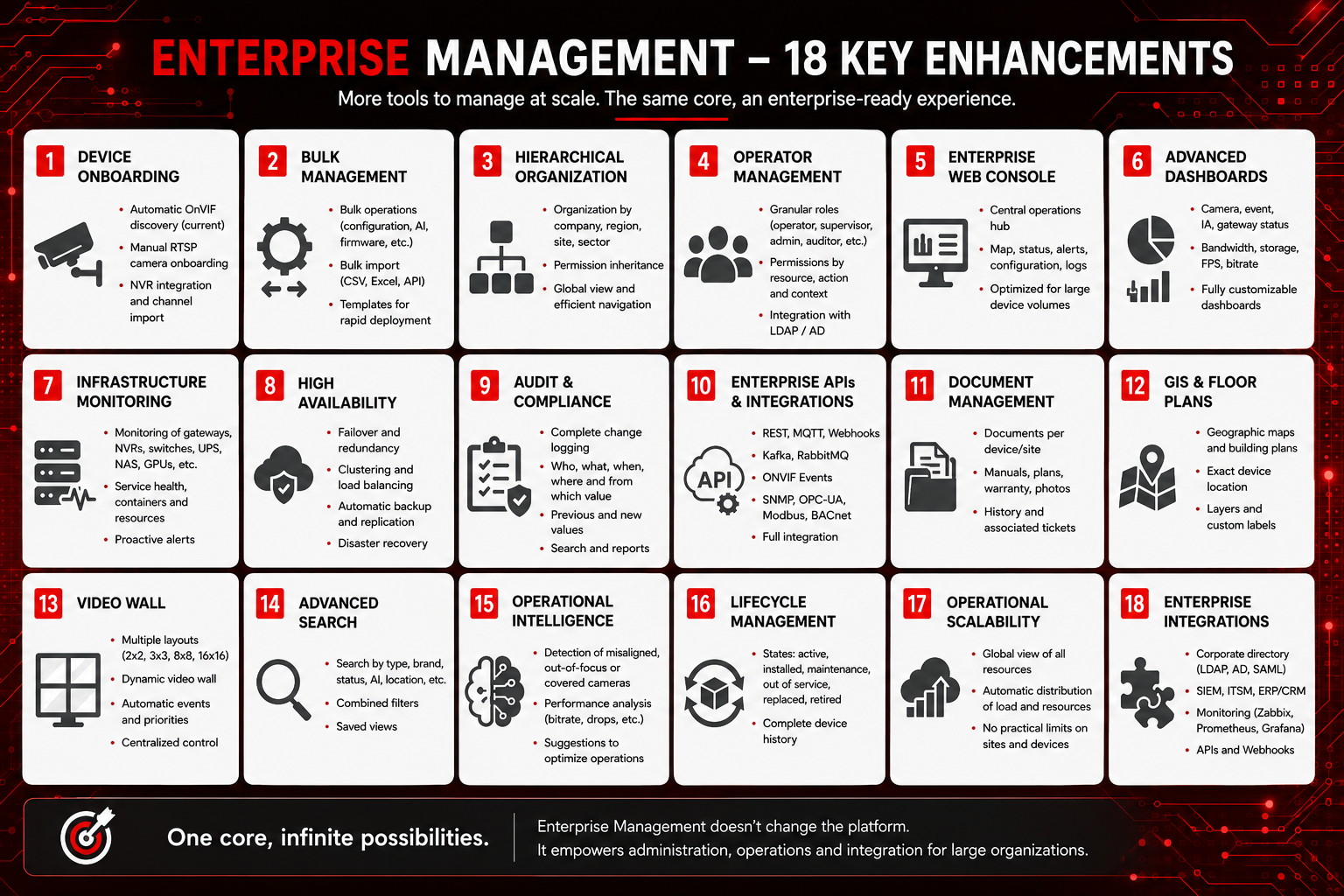
Enterprise management on a single Core
The Enterprise roadmap is distinct from the application feature roadmap. Rather than describing new residential user features, it covers the administration, operations, and governance tools required to manage large organizations, multiple sites, and thousands of devices on the same Horus Core.
The following tracks describe the planned evolution. Their scope and implementation order may change according to deployment priorities.
1. Device onboarding
- Automatic ONVIF network discovery, profile retrieval, and assisted configuration.
- Manual RTSP camera setup, including name, host, port, primary and secondary streams, credentials, codec, and resolution.
- Integration with NVRs from vendors such as Hikvision, Dahua, Uniview, and Hanwha to import channels automatically.
2. Bulk management
- Batch operations across hundreds or thousands of cameras: resolution, AI, firmware, restart, groups, permissions, and configuration export.
- Bulk imports through CSV, Excel, API, LDAP, or Active Directory.
- Reusable templates for deploying complete branches with preconfigured devices, rules, AI, and dashboards.
3. Hierarchical organization
Flexible structures such as company, country, region, city, branch, area, and camera—or holding, company, plant, area, and device—with inherited permissions at every level.
4. Operator management
Specialized roles for operators, supervisors, administrators, auditors, maintenance, physical security, help desk, and external providers, with granular permissions by resource, action, and context.
5. Enterprise Web Console
The Web becomes the primary operations center for maps, dashboards, status, alarms, configuration, logs, and analytics. The mobile application remains a complementary experience for mobility and field work.
6. Advanced dashboards
Customizable panels for cameras, offline devices, FPS, bitrate, AI CPU/GPU usage, events, alerts, bandwidth, storage, VPN status, and temperature.
7. Infrastructure monitoring
End-to-end monitoring of gateways, switches, UPS units, NVRs, NAS devices, GPUs, CPUs, disks, services, Docker containers, and Kubernetes clusters, with health metrics and proactive alerts.
8. High availability
Failover, clustering, redundancy, automated backups, replication, load balancing, and disaster recovery for critical operations.
9. Auditing
A complete record of every change: who made it, what changed, when, from where, and the previous and new values, with search and reporting.
10. Enterprise APIs and integrations
REST, MQTT, Webhooks, Kafka, RabbitMQ, AMQP, OPC-UA, BACnet, Modbus, ONVIF Events, and SNMP interfaces to integrate Horus with the operational ecosystem.
11. Document management
Documentation attached to each device or site: manuals, plans, warranties, photographs, technical history, and tickets.
12. GIS and floor plans
Geographic maps and navigable plans for floors, shopping centers, hospitals, campuses, and airports, with precise device locations, layers, and labels.
13. Video Wall
2×2, 3×3, 8×8, and 16×16 layouts, dynamic walls, centralized control, and automatic event display based on priority.
14. Advanced search
Global search by manufacturer, model, status, resolution, AI capability, location, installation date, and any other attribute, with combined filters and saved views.
15. Operational intelligence
AI applied to operations to detect misaligned, blurred, or obstructed cameras; identify abnormal bitrate and repeated outages; and recommend better load distribution.
16. Lifecycle management
Active, installed, under maintenance, out of service, replaced, and retired states, preserving the complete history of every device.
17. Operational scalability
A global view of companies, sites, cameras, sensors, gateways, and data centers. The Horus instance may remain an internal technical unit while the platform decides where each resource lives and operators work without practical scale limits.
18. Corporate integrations
- Identity: LDAP, Active Directory, OpenID Connect, and SAML.
- Tickets and operations: ServiceNow and Jira.
- SIEM: Splunk, QRadar, and Microsoft Sentinel.
- Monitoring: Zabbix, Prometheus, and Grafana.
- ERP, CRM, and automation platforms through APIs and Webhooks.